
Liters to Grams Calculator: Convert L to G for Any Liquid
Enter an amount and choose a liquid to get an instant and accurate result. Liquid not listed?
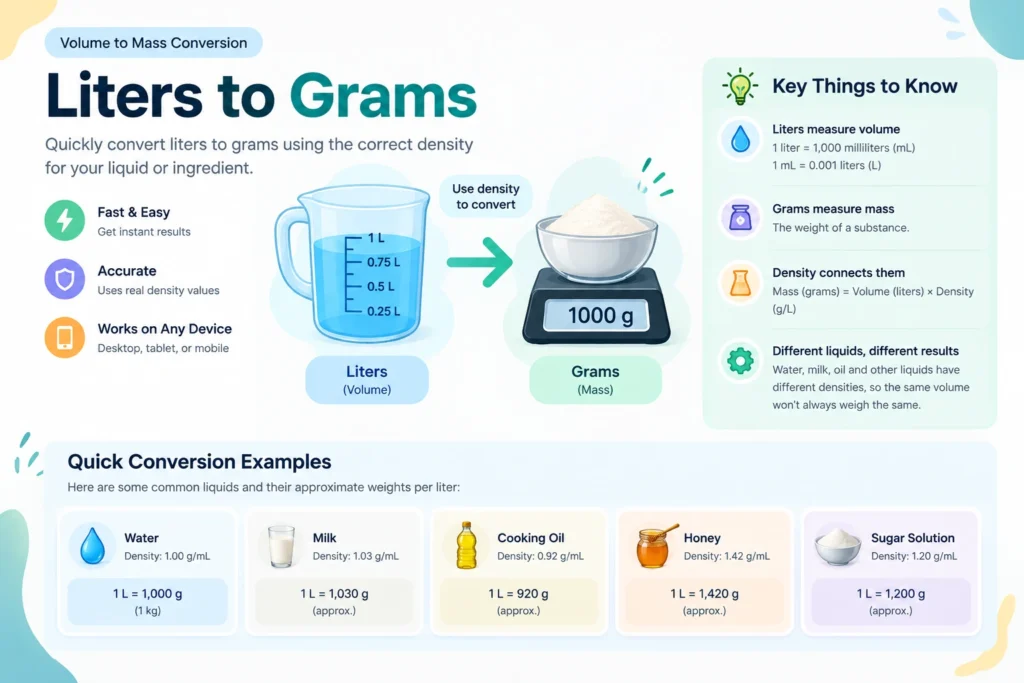
A liter measures volume, the space a liquid takes up. A gram measures mass, which everyday language calls weight. The two aren't interchangeable without knowing one more piece of information: the liquid's density.
That's why 1 liter of water weighs 1,000 grams, while 1 litre of refined oil weighs about 920 grams and 1 liter of honey weighs 1,420 grams despite all three filling the exact same size container.
How to Convert Liters to Grams
The formula is:
grams = liters x 1,000 x density (g/mL)
Multiplying by 1,000 converts liters into milliliters, since density is expressed per milliliter. If your measurements are already in mL, you can skip that step and start from milliliters instead. From there, the liquid's density does the rest of the work. As an example, converting 3 liters of milk, which has a density of 1.03 g/mL:
grams = 3 x 1,000 x 1.03 = 3,090 grams
The same 3 liters of vegetable oil, at a density of 0.92 g/mL, comes out to 2,760 grams instead, a difference of 330 grams for an identical volume.
L into Grams: 1 to 20 Liter Chart
Volume converted to weight across four liquids that span the full density range, from lighter-than-water oil to much heavier honey:
| Liters | Water | Milk | Vegetable Oil | Honey |
|---|---|---|---|---|
| 1 L | 1,000 g | 1,030 g | 920 g | 1,420 g |
| 2 L | 2,000 g | 2,060 g | 1,840 g | 2,840 g |
| 3 L | 3,000 g | 3,090 g | 2,760 g | 4,260 g |
| 4 L | 4,000 g | 4,120 g | 3,680 g | 5,680 g |
| 5 L | 5,000 g | 5,150 g | 4,600 g | 7,100 g |
| 6 L | 6,000 g | 6,180 g | 5,520 g | 8,520 g |
| 7 L | 7,000 g | 7,210 g | 6,440 g | 9,940 g |
| 8 L | 8,000 g | 8,240 g | 7,360 g | 11,360 g |
| 9 L | 9,000 g | 9,270 g | 8,280 g | 12,780 g |
| 10 L | 10,000 g | 10,300 g | 9,200 g | 14,200 g |
| 11 L | 11,000 g | 11,330 g | 10,120 g | 15,620 g |
| 12 L | 12,000 g | 12,360 g | 11,040 g | 17,040 g |
| 13 L | 13,000 g | 13,390 g | 11,960 g | 18,460 g |
| 14 L | 14,000 g | 14,420 g | 12,880 g | 19,880 g |
| 15 L | 15,000 g | 15,450 g | 13,800 g | 21,300 g |
| 16 L | 16,000 g | 16,480 g | 14,720 g | 22,720 g |
| 17 L | 17,000 g | 17,510 g | 15,640 g | 24,140 g |
| 18 L | 18,000 g | 18,540 g | 16,560 g | 25,560 g |
| 19 L | 19,000 g | 19,570 g | 17,480 g | 26,980 g |
| 20 L | 20,000 g | 20,600 g | 18,400 g | 28,400 g |
Vegetable oil is used here rather than a generic "cooking oil" figure, since density varies meaningfully by oil type, canola, olive, and sunflower oil all sit close to this same 0.92 g/mL value, within about 1 percent.
For a liquid not shown here, or an amount beyond 20 liters, the calculator above covers all 20 listed liquids at any volume. Below a liter the arithmetic is the same but the numbers get fiddlier, which is why half a liter has its own worked example.
Liters to Grams for Common Liquids
Here is 1 liter converted across the liquids most people ask about:
| Liquid | Density | 1 Liter in Grams |
|---|---|---|
| Water | 1.0 g/mL | 1,000 g |
| Milk | 1.03 g/mL | 1,030 g |
| Heavy Cream | 1.0 g/mL | 1,000 g |
| Coffee | 1.0 g/mL | 1,000 g |
| Orange Juice | 1.04 g/mL | 1,040 g |
| Vinegar | 1.01 g/mL | 1,010 g |
| Soy Sauce | 1.15 g/mL | 1,150 g |
| Vegetable Oil | 0.92 g/mL | 920 g |
| Olive Oil | 0.91 g/mL | 910 g |
| Coconut Oil | 0.92 g/mL | 920 g |
| Honey | 1.42 g/mL | 1,420 g |
| Maple Syrup | 1.32 g/mL | 1,320 g |
| Molasses | 1.4 g/mL | 1,400 g |
These figures scale linearly, so 2 liters of any liquid above weighs exactly double, 0.5 liters weighs exactly half, and so on. The calculator above handles any amount and includes several more liquids not shown in this shortened table.
Why 1 Liter Isn't Always 1,000 Grams
Water is the liquid most people default to when estimating weight from volume, and it's a reasonable shortcut, since water's density sits almost exactly at 1 gram per milliliter.
The trouble starts when that shortcut gets applied to everything else. Cooking oils are consistently lighter than water, typically by 8 to 9 percent, because their molecular structure packs less mass into the same space. A full liter of vegetable oil therefore comes in under a kilogram, at 920 grams.
Honey and syrups go the other way, weighing 30 to 40 percent more than water at the same volume, since they're dense, concentrated solutions with very little water content of their own.
Neither is an exception to a rule; they're just liquids with their own density, and the formula above accounts for that automatically.
Using a Density Not Listed Here
Not every liquid has a universally agreed-upon density, and some substances fall outside the common kitchen and pantry list altogether.
For those cases, the calculator includes an option to enter a density value directly, in whichever unit it's already available in, grams per milliliter, kilograms per liter, pounds per gallon, and several others.
This avoids the extra step of converting a spec sheet or reference value into g/mL by hand before it can be used.
Where This Conversion Actually Comes Up
Most often it is a recipe written in volume meeting a kitchen scale, which only reads weight. Scandinavian recipes take this furthest, listing flour and milk in deciliters rather than cups or grams.
Outside the kitchen, liquid freight is billed and manifested by weight, so the same calculation runs in pounds for a US carrier, or in metric tons once you are dealing with tanker volumes.
In chemistry and lab work, a solution prepared by volume often needs its mass calculated for a reaction to proceed correctly, sometimes at the milligram or even microgram level. In each case, the density of the specific substance involved is the deciding factor, not a general rule of thumb.
Frequently Asked Questions
Why do I need to know a liquid's density to convert liters to grams?
Grams measure weight and liters measure volume, and there's no fixed relationship between the two unless the liquid's density is known. Density describes how much mass is packed into a given space, and it's different for every liquid. Without it, a volume measurement like "1 liter" could represent anywhere from about 900 grams to over 1,400 grams, depending entirely on what's being measured.
Does temperature affect a liters-to-grams conversion?
Yes, though usually only slightly for everyday use. Liquids expand a little as they warm up and contract as they cool, which changes their density and therefore their weight at a fixed volume.
For most cooking and household purposes, this difference is small enough to ignore. For lab work or industrial applications where precision matters, density figures are typically specified at a particular reference temperature for exactly this reason.
Can this formula be used for substances that aren't liquid?
The same density-based formula works for any substance, not just liquids, as long as an accurate density value is available. Powders, granular solids, and semi-solids like flour, sugar, or peanut butter each have their own density and can be converted the same way. The custom density option in the calculator above works for any of these, not only the liquids listed by name.
More Specific Conversions
For a full breakdown at one exact amount, including a comparison across 20 liquids and a plain-language explanation for that specific number:
- 0.001 liters to grams
- 0.05 liters to grams
- 0.1 liters to grams
- 0.2 liters to grams
- 0.3 liters to grams
- 0.4 liters to grams
- 0.5 liters to grams
- 0.6 liters to grams
- 0.7 liters to grams
- 0.8 liters to grams
- 0.9 liters to grams
Other Units on This Site
The same density figures drive the rest of the converters here: liters to ounces for US recipes and bottle labels, centigrams and nanograms for the finer end of lab work, and centiliters to grams for European drinks measures.
Data Sources and References
Our calculators use standard, widely published density values for water, milk, oils, honey and syrups, consistent with the FAO/INFOODS Density Database. Where a liquid varies by brand or composition, we use a representative average, and the same value appears in every calculator and table on this site.
Unit definitions follow the BIPM SI Brochure for the gram and kilogram, and NIST for the liter.
Density shifts with temperature, brand and composition, so these figures suit everyday cooking, baking and general reference, not laboratory precision. For pharmaceutical work or regulated food production, source a certified density for that exact product rather than any general reference figure. Spotted a value that looks wrong? Tell us and we'll review it.